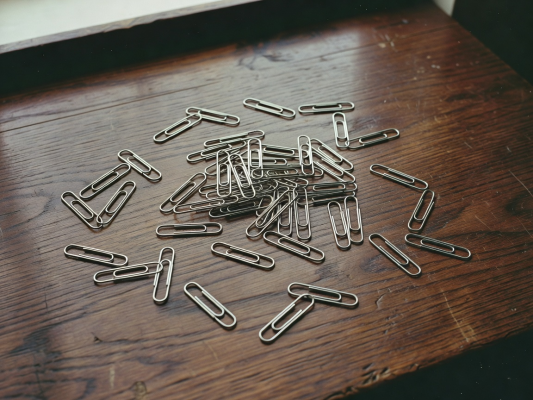
In the expansive history of human ingenuity, the paperclip stands out as a triumph of minimalism. It has no moving parts, requires no external tools to operate, and utilizes a single material. Yet, the evolution of this tiny wire loop reveals a fascinating interplay between industrial capacity, office administration, and intellectual property.
Prior to the late 19th century, keeping sheets of paper together was a cumbersome affair. In medieval Europe, wax seals and ribbons were the standard for official correspondence. By the Victorian era, the straight pin—much like those used by modern tailors—was the primary method for temporarily attaching papers in offices. However, pins caused problems: they rusted, they pricked the fingers of clerks, and they left permanent, unsightly holes in documents.
The dawn of the Industrial Revolution brought steel wire that was both flexible and resilient. The combination of cheap steel and new machinery capable of rapidly bending wire into specific shapes set the stage for the paperclip's invention. Between 1890 and 1920, dozens of patents were filed for various wire paper fasteners, each attempting to balance grip strength with ease of application.
The Norwegian Myth and the Patent that Wasn't
A persistent historical myth attributes the invention of the paperclip to a Norwegian inventor named Johan Vaaler. Vaaler did indeed patent a paperclip design in Germany in 1899 and in the United States in 1901. However, his design was fundamentally flawed: it lacked the inner loop that provides torsion and structural integrity. Furthermore, Vaaler’s patent was granted merely because the specific, inferior iteration he designed had not been previously registered.
The paperclip we recognize today—the double-oval design known universally as the Gem clip—was actually in production several years before Vaaler filed his patent. The Gem Manufacturing Company in Britain began producing this iconic shape in the early 1890s. Ironically, the Gem clip was never patented. Its design was so elegant and so obviously functional that it quickly became a generic standard, completely dominating the global market despite fierce early competition from alternative designs like the "Fay," the "Niagara," and the "Owl."
Comparative Analysis of Early Fasteners
| Fastener Type | Era of Popularity | Material | Drawbacks |
|---|---|---|---|
| Straight Pin | 1850s–1900s | Brass / Iron | Punctured paper, rust, risk of injury |
| Fay Clip | 1890s–1910s | Steel Wire | Triangular shape tore paper upon removal |
| Gem Clip | 1890s–Present | Galvanized Steel | Tends to warp if over-extended |
| Binder Clip | 1910s–Present | Spring Steel & Wire | Bulky, leaves deep impressions on paper |
The Physics of the Gem Clip
The success of the Gem clip lies in its application of Hooke's Law of elasticity. When paper is inserted between the two wire loops, the steel wire is forced to flex slightly, creating a spring-like tension. The outer loop presses down, while the inner loop pushes up, creating sufficient friction to hold the papers together without tearing the fibers of the cellulose.
Today, billions of paperclips are manufactured annually. While the digital age has reduced our reliance on physical paper, the paperclip remains ubiquitous—often repurposed as a tool for resetting electronics, picking basic locks, or serving as a makeshift hook. It is a testament to the fact that perfect design rarely needs an upgrade.