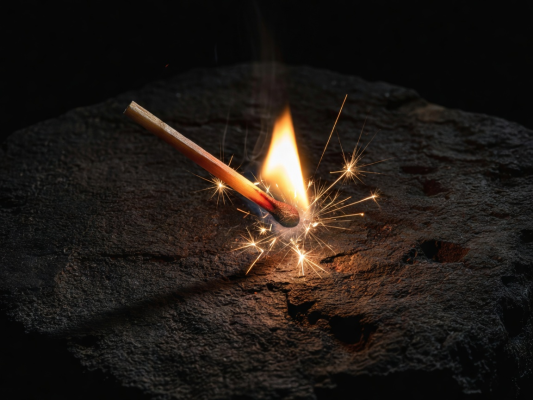
Creating fire on demand has been a central pursuit of humanity since the dawn of civilization. For millennia, our ancestors relied on friction (the bow drill) or percussion (flint and steel) to generate a spark. It wasn't until the 19th century that chemistry offered a seemingly magical alternative: a stick that burst into flame with a simple swipe.
The modern friction match was an accidental discovery. In 1827, English chemist John Walker was experimenting with chemical explosives. Stirring a mixture of antimony sulfide, potassium chlorate, gum, and starch, he noticed a dried lump of the mixture stuck to the end of his stirring stick. When he scraped the stick against the stone floor to remove the lump, it violently ignited.
Walker named his invention "Congreves" (after a type of rocket) and began selling them in tin boxes. However, Walker did not patent his invention. Samuel Jones saw a demonstration of Walker's matches and quickly commercialized his own version, calling them "Lucifers." These early matches were erratic, emitted a foul-smelling sulfurous gas, and frequently showered the user in burning chemical sparks.
The White Phosphorus Crisis
In 1830, French chemist Charles Sauria made a critical adjustment: he added white phosphorus to the match head formula. This made matches easier to strike, eliminated the worst of the foul odors, and significantly lengthened the burn time. "Strike-anywhere" matches became a massive global industry almost overnight.
But the convenience came at a horrific cost. White phosphorus is highly toxic. Workers in match factories—often young women and children—were exposed to phosphorus fumes daily. The exposure led to a devastating occupational disease known as phosphorus necrosis of the jaw, or "phossy jaw." The disease caused severe pain, abscesses, and the gradual necrosis (death) of the jawbone, often resulting in severe disfigurement or fatal brain damage.
Despite public outcry and strikes, such as the famous Matchgirls' Strike of 1888 in London, governments were slow to act because the match industry was highly profitable. It took the 1906 Berne Convention to secure an international agreement banning the use of white phosphorus in matches.
The Invention of the Safety Match
The solution to both the toxicity of white phosphorus and the danger of strike-anywhere matches igniting accidentally was the "safety match."
Invented in 1844 by Swedish chemist Gustaf Erik Pasch and later commercialized by J.E. Lundström, the safety match separated the combustible ingredients. Pasch discovered that non-toxic red phosphorus could be used instead of white phosphorus. However, instead of putting all the volatile chemicals on the match head, he placed the red phosphorus on the striking surface of the box. The match head contained only potassium chlorate and sulfur.
| Match Type | Key Active Chemical | Ignition Method | Safety Profile |
|---|---|---|---|
| Early Lucifers | Antimony Sulfide | Friction on any rough surface | Explosive, erratic, poor odor |
| Strike-Anywhere | White Phosphorus (historical) | Friction on any rough surface | Highly toxic to workers, prone to self-ignition |
| Modern Safety Match | Potassium Chlorate (Head) | Red Phosphorus (Box Striker) | Non-toxic, only ignites on specific surface |
Modern Match Manufacturing
Today, matches are manufactured by the millions using highly automated processes. Aspen wood is preferred for the splints because it is porous enough to absorb the chemical treatments that prevent the stick from smoldering after the flame is blown out (a process known as anti-afterglow). The tips are dipped in wax to help transfer the flame from the chemical head to the wood, ensuring a steady burn.
Though lighters and electronic ignition systems have largely superseded them in everyday use, the friction match remains a symbol of chemical ingenuity—a literal spark that bridged the gap between ancient survival techniques and modern industrial chemistry.